Product 🥊 Tech
This is what a product-driven organization looks like:
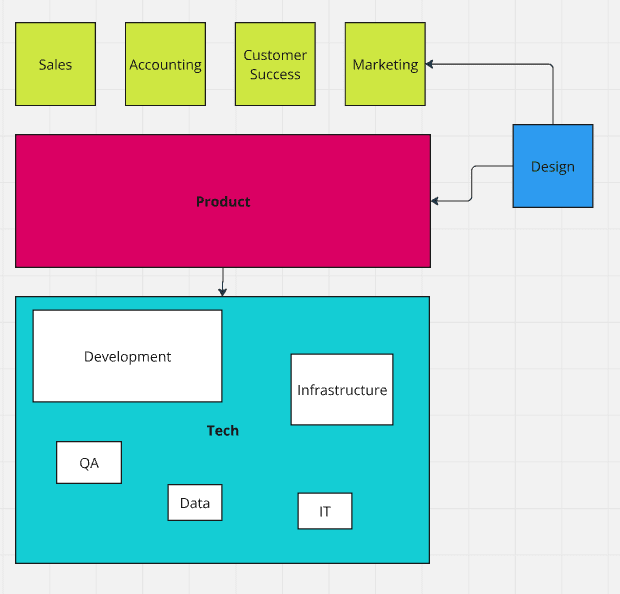
And I have yet to see one that does this effectively.
The idea is, that you have a strong product department that figures out the customers’ needs, what features need to be built, and how they should look like.
The tech team then builds those features and ships them to the users.
The trouble is…
Every time I’ve seen this in practice it ended up with waterfall and silos.
Here are a few issues:
- The product involves tech too late in the planning stage, without knowing the impact of a feature.
- Lots of information is lost when passed through JIRA tickets from one department to another.
- Tech is seen as just an execution engine, not a driver of innovation.
- Product pushes too many features into execution, straining the dev team who then becomes defensive.
Progress stalls.
It’s made worse by a lack of ownership and accountability. When things are passed between the teams, it’s easy to blame the “other team”.
We built it to spec, it’s your assumptions that were wrong!
Until everyone is pointing a gun at everyone else.

The thing is …
Sometimes I get asked by someone who wants help and describes the above organizational structure why any feature they want to ship is met with resentment and is a damn effort to get to production.
It’s because you designed your organizational structure for friction not flow.
If you want to succeed, it’s much better to have small cross-functional teams that are responsible for a chunk of the app.
You’ll want to have shared goals that drive the business forward.
You’ll want a tech team that feels encouraged to contribute solutions instead of working “to spec”.
And you’ll want transparency so that everyone feels they are a part of the same mission.
The next time I walk into this kind of organization, I’m smashing my sledgehammer against the org chart and we’re rebuilding with the reverse-Conway maneuver as described in Team Topologies.
With flow, accountability, and ownership in mind.
P.S. Has this setup ever worked for you? Please prove me wrong, I’d love to get a counter-example.
Best regards,
Taj